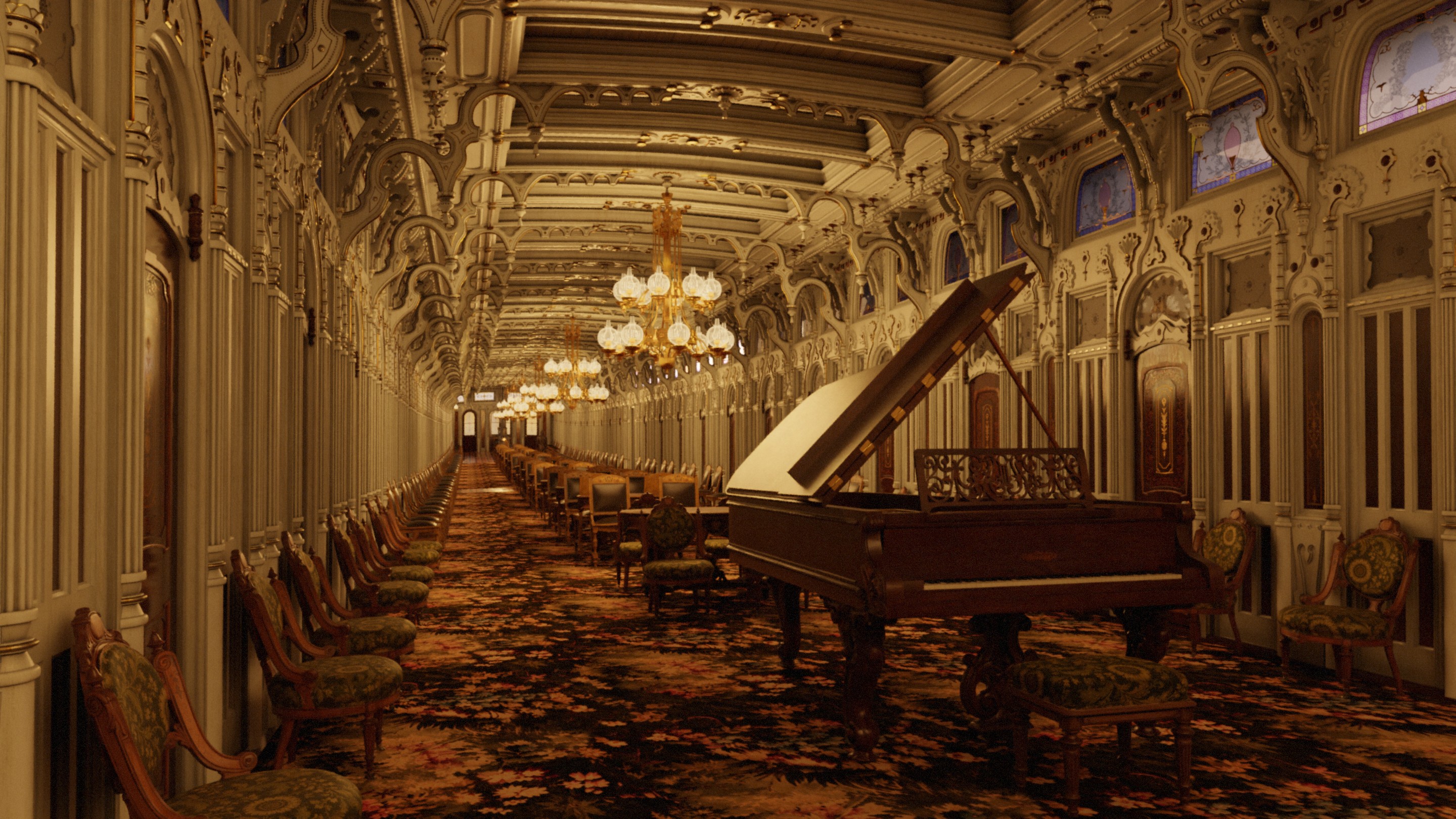
The J.M. White’s Rosewood Cabin and Chickering Grand
The J. M. White was designed to impress. Its cabin furniture was made expressly for the vessel by J. Ziegler & Co. of New York. The pieces were constructed of solid rosewood and finished with expensive decorative materials, carving, and other ornamental details. 1
An original photograph of the cabin gives us an opportunity to look past written descriptions and study the room as an actual interior. Beside it, the Blender reconstruction offers a second way of seeing the same space: not as a preserved room, but as an interpretive digital model.
The most important visual connection between the two images is the Chickering concert grand. The piano was part of the cabin’s carefully planned ensemble rather than an isolated musical instrument. It belonged among the carved furniture, decorative surfaces, carpets, lighting, and other elements that transformed the passenger cabin into a luxurious social space.
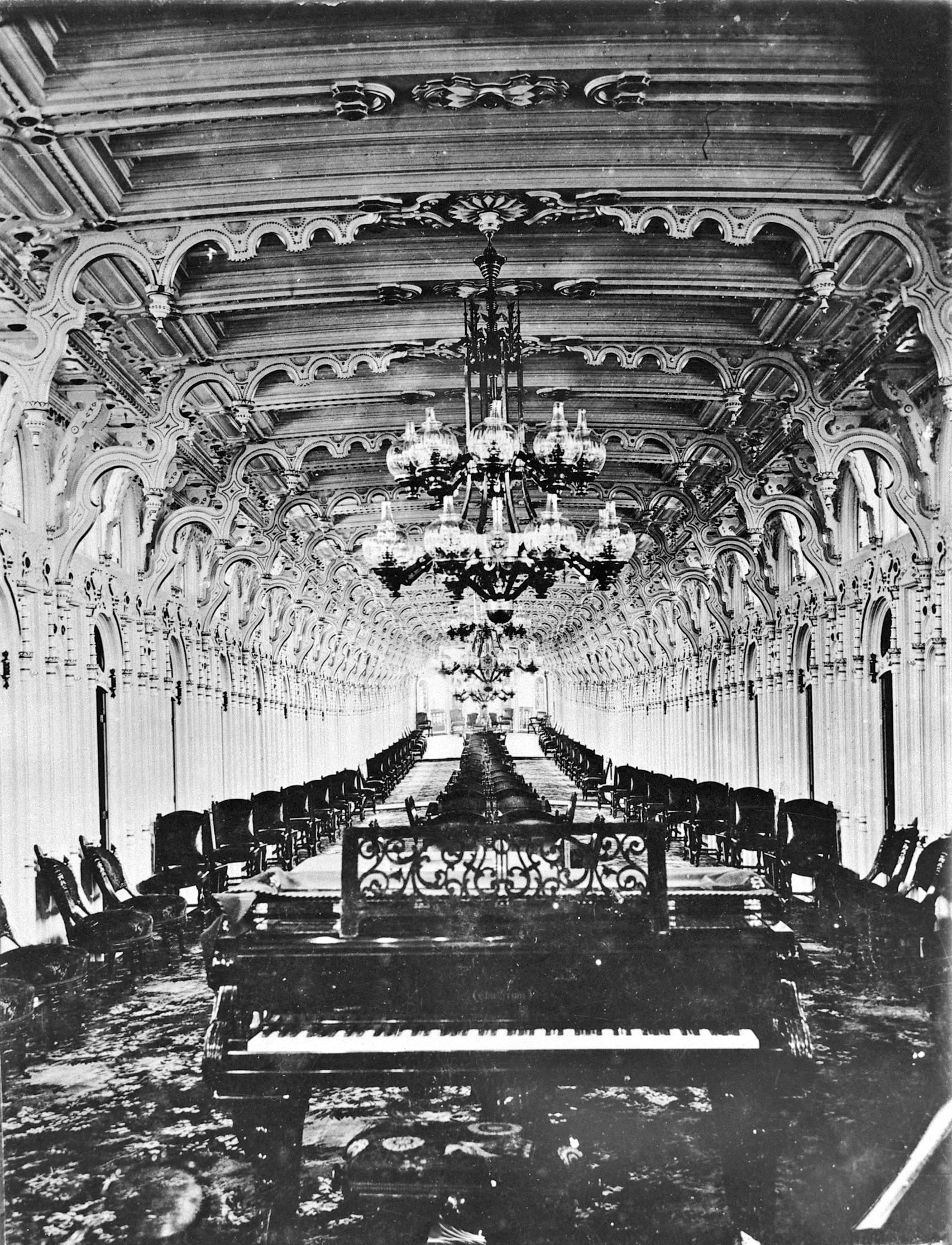 Figure 1: original photograph of the cabin of the J. M. White, with the Chickering grand visible. Courtesy of the Murphy Library, University of Wisconsin La Crosse (J. M. White (Packet, 1878-1886) - UWDC - UW-Madison Libraries)
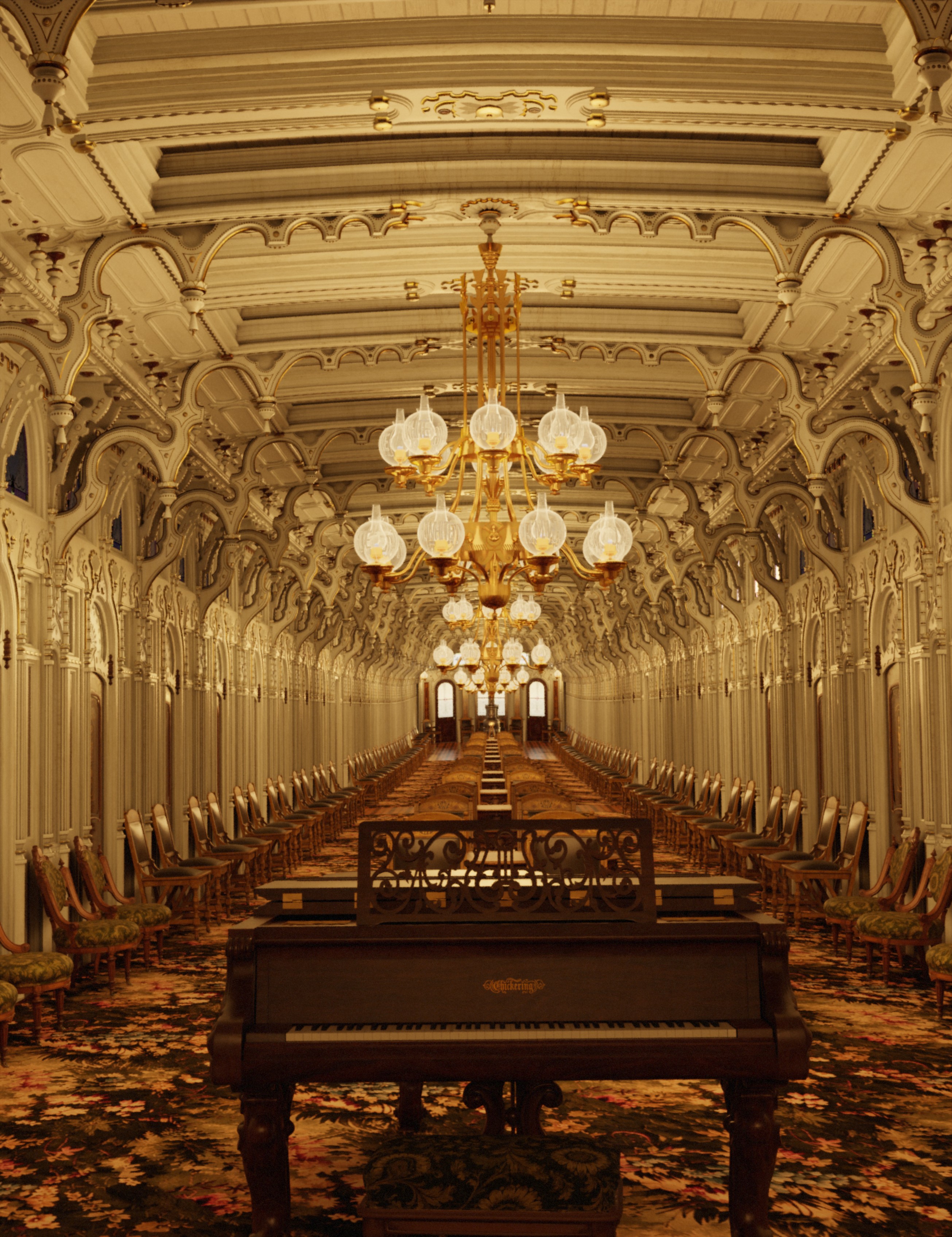 Figure 2: Blender reconstruction aligned to the same viewpoint. The rendering is an interpretive reconstruction based on the photograph and written descriptions of the vessel’s furnishings.
The J. M. White’s piano was a full concert grand made by Chickering & Company of New York. It had been selected by Col. Thompson Dean and was described at the time as “elegantly carved” and “a masterpiece of workmanship.” 2 Placing it back into the reconstructed cabin helps restore some sense of its original setting.
The comparison between photograph and rendering should not be read as a claim that every modeled detail is certain. Some features can be matched directly to the photograph, while others must be inferred from the surviving descriptions of the boat’s furnishings. The rendering is therefore both a reconstruction and an argument: it proposes how the cabin may have functioned as a coherent interior.
The cabin was not simply a corridor lined with rooms. It was a setting for display, conversation, music, and movement. The piano would have contributed to that atmosphere, visually as well as musically. Its carved case and polished surfaces would have complemented the rosewood furniture and the highly finished character of the room.
There is also an intriguing reason to think about the cabin as a collection of movable objects rather than a space that vanished all at once. Later accounts reported that chairs from the J. M. White survived in St. Louis, Little Rock, Tell City, and New Orleans. The same account suggested that the vessel may have been stripped of some of its finer fittings before the fire that destroyed her. 3
That possibility gives the photograph and the reconstruction an additional purpose. The photograph records the cabin as an assembled interior. The digital model allows us to disassemble and examine that interior—to ask which objects were permanent parts of the boat, which could be removed, and how the piano related to the room around it.
The result is not a literal recovery of the lost cabin. It is a visual hypothesis grounded in the surviving photograph and contemporary descriptions. The original image shows what remained to be seen; the rendering explores what may have stood just beyond the limits of the surviving record.